Friday, May 21, 2010

More Planking (but finally some progress)

Ok, I've just had three days of intermittently interrupted days for getting some planking done and I have to say it's finally starting to get somewhere.

These photos show Wednesday's results (lots of interruptions that day).


Here's Thursday's results.


And finally Friday's. She's actually starting to look like a boat.


Fitting the garboards proved to be interesting. They need to be beveled where they meet in the center, which sounds much simpler than it actually turned out to be. I started by using my freshly sharpened chisels but it was slow & awkward in work and the result was pretty ordinary.


So I opted instead to set up my trusty sanding station in the back yard & set the shelf thingy roughly to a 45 degree angle. Then, donning mask, I quickly sanded the bevel on the garboard planks.


In the end, the angle I'd arbitrarily used was too sharp, meaning that the edges don't have too much surface contact but I decided to use them anyway. I'm planning to triple up on the layers of fiberglass in this area, plus I'd hate to waste such beautiful wood. Besides, the join does match up pretty good otherwise.


Then I managed to get another couple of levels of planks in as well. The Japanese Pull Saw is an excellent tool for the precision work of cutting the hood ends (even with the teeth starting to fill up with glue). I was able to get quite accurate, which surprised me no end.


So far, one potential problem that has had me stressing has been the edge-setting of the planks in the ends. I've found it very difficult to get the planks to lay completely flat, meaning that in some parts it is almost a clinker type finish. I don't know whether or not this tendency has been exasperated by my leaving the end molds with the extra width.
Gary's book says that you can tape up a small strip and staple to it between stations to help maintain edge alignment, but because I'm hoping to have the topsides finished clear, I didn't want to leave heaps of staple holes between the molds. I'm really hoping that I can still fair it all in without losing too much timber. Since I'm planning to paint below the waterline, I'm not so worried in that area because it's a simple matter of fairing any hollows with filler, but that's obviously not an option if it's an area that's to be finished clear.

Oh well, nothing for it but to wait and see how it looks once I've scraped the 3.75 tons of dried glue off & sanded/faired the whole hull. It'll be a terrible shame if I end up having to fill & paint the topsides & cover up all that nice timber grain.

I've entered the crap part of the roster again, so my next window of opportunity isn't until Tuesday. With a bit of luck, I may get the planking finished then.

Sunday, May 16, 2010

Planking Begins (just)

Well, Saturday was a bit of a loss & Sunday got pretty chewed up too (lots of usual family duties), but at least I did get something productive done on the canoe in the end.

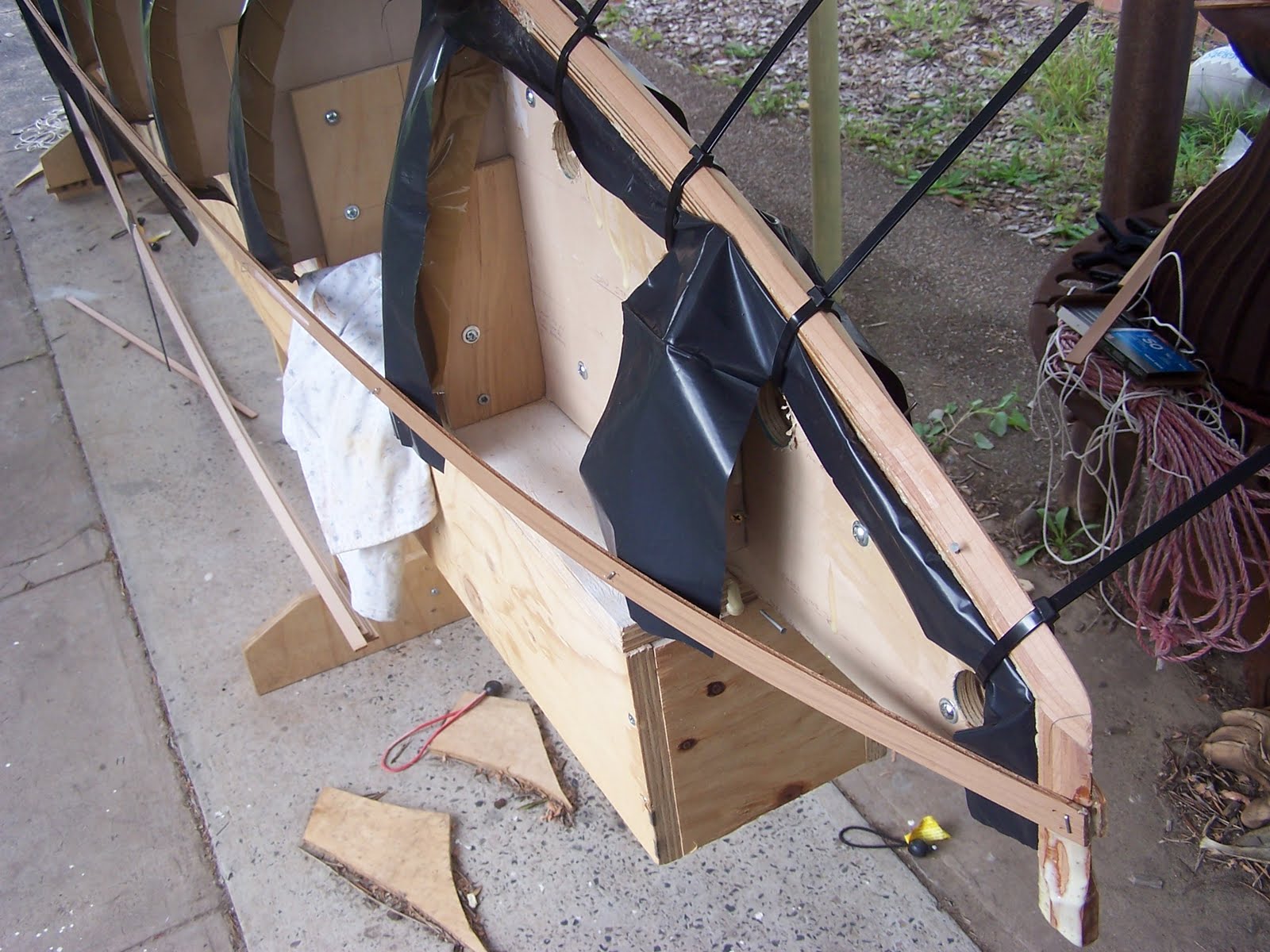
After the usual Sunday morning family cook-up breakfast yesterday, I went out to see if I could get this mythical planking process under way. I covered the stem molds in black builders plastic that I had picked up Saturday afternoon. Then I used cable ties to secure the permanent stems to the stem molds, with a couple of thin nails thrown in for good measure.

Bow shot.......


.....and stern.


Then I had to stop, so as to head back out to the Army Cadet camp to pick up my son & his mate. It wasn't until about three hours later before I was able to get back onto the job.
Working as fast as I could, I cut more strips of the plastic & covered each of the intermediate molds with them. Once this was done, it suddenly dawned on me that I was finally ready to start whacking on some planks.

With this project about to move further into the harsh world of non-reversible reality, I nervously grabbed the first couple of planks & got to the task of aligning & fitting them. I think I got the sheer strakes reasonably straight. I followed the edges of the molds as best I could, and to my novice eyes it all looked ok.


The light just beginning to fade but I desperately wanted to get at least one more round of planking on each side before knock off, so I ploughed on. This second lot of planking took a bit more fiddling around, mainly due to my wanting to stagger the butt joints as much as possible. Even so, It didn't take very long at all and I started to get excited at finally seeing a more three dimensional outline of my boat emerging.


One part that had me worrying was the edge alignment toward the ends. The planks just wouldn't maintain the twist that I would've liked, meaning that the bead of the second strake wouldn't quite lay properly into the cove of the sheer strake. I tried & tried to correct it but, in the end, I just had to accept it. It doesn't seem to be out by all that much, & it'll hopefully sand flush anyway, but it's not perfect & it bugs me. Similarly, the gaps at the stems (mainly the bow), caused by my amateurish shaping efforts, came in for some fussing and swearing.
Of course, these minor defects will hopefully be compensated for by my seemingly unavoidable tendency to absolutely drown everything in copious amounts of glue.

Speaking of glue, I called up Dave from Drive Marine Services in Beverly Hills, NSW (our local Boat Craft Pacific people) and spoke to him about my glue concerns. He was excellent & told me that the stuff that they sell, while slightly better than what I've already got, would behave in a similar manner with regards to foaming out of gaps. He recommended that, since I'd already bought the durabond, it should be fine to use & to save my money. That's honesty & service that you don't find every day.

I must say that I've been pretty impressed with these guys in general. Some of their stuff was a bit more expensive than elsewhere, but other items were quite competitive. Moreover, when trying to get quotes and/or information from loads of other confusing/ignorant sources, Dave & his people couldn't be more helpful. I would highly recommend them.

Tuesday, May 11, 2010

Testing Times Again

Yes, testing times again but don't worry. I'm not about to start whinging about not planking yet. In fact it's all good.

Today got off to a great start with an early morning swim before brekky (got to get back in training, so I'll be able to fit in this canoe when it's finished). Then, after a relaxing few coffees, the rest of the morning got absorbed with fixing a folding machine for my wife's business. Once that was done, it was time for a quick early lunch and I finally got stuck into the boat in the early arvo.

I'd come to the conclusion that I've been stressing needlessly over this whole planking business. This boat will be "born" when it's ready & striving to "induce the birth" will only lead to defects & a crap finish. I've now resolved to just focus on the next few steps at a time & let the boat dictate when it get finished. I think I was getting impatient partly because of the magnificent weather we've had lately & I can't stop imagining being out there in my canoe.

Firstly, I sussed out a solution to a potential stuff up I'd made on the newly widened stem molds. When initially setting up the molds at Stations 1 and 17 (the first ones at each end, mounted on each side of the stem molds), they had to have a strip cut out of the middle, exactly the width of the stem molds, then attached to either side. Back then these stem molds were 12mm but they are obviously double that now, meaning that the strip I'd cut is only half as wide as it should be. I'd just thought of it yesterday. I was about to remove them again and cut a 6mm strip off each side, re-affix, re-tape and re-shape the permanent stems to the new angle. But after pondering for a while & fidgeting with battens, I decided to leave it. It will marginally increase the volume in the bow & stern, which may slightly increase resistance when paddling, but couldn't hurt when sliding down a wave out at Box Head. Plus I intend to carry loads from time to time (camping, diving, fishing gear, etc), so it could actually come in handy. Besides, if I wanted a boat solely based on paddling performance, then I'd have gone for an OC1. I doubt I'll be able to notice the difference anyway.

That decided, I got on with finishing off the permanent stems. I removed the bow stem & gave it the sanding treatment. In short time it was all done & ready for planking.


When I removed the bow stem, I noticed that it had stuck a little to the stem mold, where I had re-glued the short vertical bit. Not much, but I did have to use just a little bit of force to get it off, even though there was hardly any glue overflow there. This had me wondering about the task of removing the fully planked/fiber glassed hull from the assembly.
I think I'm going to put a layer of sheet plastic over the whole mold assembly before planking now. At least then I should be sure to be able to remove the hull without damage and swearing.

I think I'm now pretty much at the point where I can finally starting planking (no hurry). Since it was getting a bit late in the day, I thought my time would be best spent working on my test panel. I'm keen to see what this Bote-Cote stuff is like to work with. It's supposed to be easier to use & less hazardous for incompetents like me.

I took the panel out onto the lawn & merrily sanded the rough side. I'm so glad I did this, because it brought to light a potentially horrible problem. It seems the glue I've been using might not be so good for my purpose. It foams up in the joints (which is great) but where there are biggish gaps, it can leave big voids (which sucks).


I think that the stems should be ok, because so far I haven't found any gaps or voids in them. Because my planking stock edges all have bead & cove finishes, there shouldn't be any gaps there either but I reckon it'll be cheap insurance to use something more appropriate. Pacific Boatcraft, who supplied all the glassing stuff, also sell some glue that is supposed to be good for strip planking, so I'm going to splurge out on that instead.

Anyway, I set up in the shed & let the fun begin. The blue stuff in the photo is "peel ply". I've heard the name of this before, but I'd no idea how it works. Only that it apparently helps leave a very smooth finish.


Stepping through the instruction booklet, I mixed up a small batch of epoxy & proceeded with the sheathing. I'm something of a fiber-glassing virgin but this epoxy seems so different to the polyester resin that I've been playing with lately. I hope I mixed it right. It was much thicker than I expected, sort of the same colour & consistency of.......well.....shall we say certain gentlemanly fluids.

Once I'd wet out the fiberglass with a thickish coat of epoxy, I used a small consolidating roller over the sheet of peel ply. It went pretty smooth, except for a bit of a wrinkle that I just couldn't seem to get rid of. Apparently now I've got to wait till it all cures, and then peel the peel ply off again, to reveal a smooth surface that requires relatively little sanding.


You can see the wrinkle a bit better in this photo (going across the grain).


Since I had some left over epoxy, I decided to give a scrap piece of ply a good coat, to see how it goes too. I've got my eye on a particular boat design that I'm thinking about building in the future (a Tahitian double canoe), which is constructed of stitch & tape ply (see James Wharram site for 21 ft Wayfarer design).


So, there you go. Only a half day, but pretty constructive none-the-less I think. I've got to wait until the weekend now, before I can play some more. Maybe even.......a spot of planking?

Friday, May 7, 2010

Planking Delays

Boat building sucks. It's like pushing runny poo uphill with a pointy stick. I had all good intentions of having a half planked hull by this time tonight but, despite a very busy day, things didn't work out quite like that.

First up I, I took the stems off the molds to shape them in readiness for beveling. That went easily enough.

Before...


After. Too easy.


I took them back & clamped them onto the molds. Then I figured I'd take a (quick) closer look at a couple of intermediate molds, to see if I could work out why they "weren't quite right". In mounting the molds, I was always as careful & accurate as I could be but a few molds still seemed to be out by a few mm.


Anyway, after lots of time and much jiggling, batten adjusting, head scratching & measuring (nearly ALL) waterlines against the table of offsets, I finally discovered that some of the waterlines on the templates seem to be a couple of mm out in places. These appear to have combined to cause the slight anomalies with mold alignments.


Mulling over a plan of action and playing around with some of my planking stock, a simple solution occurred to me. If I just don't staple the planks at stations where the molds are a bit smaller, then the planks won't get pulled in and unfairness in the hull should be eliminated. I don't want to get bogged down with shimming/packing out the molds and besides, the strength is going to come from the glued edges anyway.

Very conscious of the huge amount of time I'd just wasted, I decided to move on with the beveling of the stems. This was fun (flat spokeshave seemed the best tool to use). I have to say, I thought it was very therapeutic, sitting there carving away. Wasn't overly skillful & I probably looked like a bit of a butcher but it turned out surprisingly ok. The only problem was that the short , fragile, vertical section broke out again (a bit too vigorous with the side pressure), so I had to glue it back in afterward. I'm holding it in position in the photos below.


Because this part took forever, when I got to working on the stern stem I decided to try something different. I marked roughly where I'd have to bevel, then removed it & took it to my sanding station (set up on the grass, so as to not fill my shed up with toxic cedar dust).
This seemed to work really well & I managed to do the whole stern stem, instead of just up to the first clamp like on the bow stem.


By the time I got all this sorted, it was late arvo & the normal family duties were calling. So I packed up & fumed quietly at the missed opportunity of finally getting some planks onto the molds. I'm back into the crappy half of my fortnightly roster, with only Tuesday next week available to try & make some headway. At least I really should be able to start planking now (after finishing off the bow stem of course). How long could it take?........

Those people out there who are experienced in the boat building world, or construction in general, are probably scoffing at my naivety in accurately projecting likely job time frames. Perhaps I'm just getting a little too impatient. It just seems such a bloody long time & so much work, before I even get to the starting point. Surely things will pick up now? Won't they?

Thursday, May 6, 2010

All Set for Planking

Yesterday was insanely busy, so I wasn't able to post about my progress.
I got up to Rick's factory to find he'd been busy in setting up his router for my little milling operation. It was all aligned properly & he'd made up a brilliant jig which completely enclosed the spinning bit & held the planks perfectly against it. I was spewing I'd forgotten to take my camera. It only took me about one & a half hours to mill all of the planks & they came out great.

Rick had also sussed the fact that the beaded edge of the planks aren't exactly a true radius. Plus the fact that one edge of the newly milled coves tended to be very slightly rougher than the other (if that makes sense), so he made a point of showing me how to select which way to slide the planks into his router jig, to obtain the best possible fit/finish when eventually fitting the planks onto the molds. He further instructed me to mark the best face (which will end up on the outside of the boat) with chalk, so as to simplify things for me later. How's that for attention to detail? Man I owe this bloke, big time. I reckon I would've botched this job if left to my own devices. As if all that wasn't enough, he even delivered the planks that I couldn't fit into my car, to my home after he finished work.

Anyway, the rest of the day/night was taken up by a combination of the usual kid's stuff, a trip to our financial planner and dinner/movie for our 15yr wedding anniversary, so not much more canoe action. Still, a very productive & satisfying day.

It was with much anticipation that I uncovered the canoe this morning. To my amazement, the clamps did come off (with a bit of gentle persuasion). Unfortunately, the same couldn't be said for the permanent stems. It would seem that the overly conscientious application of 350, 000 mega-liters of glue is not the method of choice for laminating up stem assemblies. Who knew?


Never mind, at lease it seems the glue DOES work. I spent most of the day getting the stems off and cleaned up a bit before refitting them to the molds. The short vertical bits did break off, so I had to re-glue them, meaning that I can't start beveling (to receive planking) until tomorrow now.


Whilst all this was going on, my fiber glassing supplies finally arrived. I got real excited when I realised that pretty much everything I need to build this canoe, is now on site. My only limitation now is time.

One canoe.......(some assembly required).


In preparation for planking tomorrow, it was time to tape up the molds. I'm really hoping to be able to get the canoe off the molds relatively easily afterward. See how it goes anyway (maybe control myself a bit with the glue this time).


Tomorrow's plan is to start the bevels on the stems and......(deep breath)....start planking!

Sunday, May 2, 2010

Glued Stems and Alignment Checks

Slow start to the day this morning (I do love my Sunday morning cook up brekkies), but once I got started, I managed a pretty productive day.

First up, it was finally time to glue the stem laminates. A quick inspection of the test panel revealed that the glossy 3M packaging tape was the most "non-stickiest". So I quickly taped up the stem molds as best I could and launched into the gluing process with gusto.
Geez, what a slippery, slimy mess I created. With much jiggling, fiddling & farting around, I managed to get them all glued & clamped.


Could definitely have done with an extra three pair of hands, but with a bit of patience it was finished relatively fast. Got a suspicion that I may have glued my clamps to the job though.


There you go. Bit of a bloody mess, but at least it's done. I'm open to suggestions as to how I can incorporate the clamps into some sort of design feature.


After that, I had another look at the test panel. It looked like a bit of a Frankenstein job, with the edges of the fiberglass tape going across & all of the lumps & bumps. Undeterred, I gave it a bit of a sand, followed by another thickish coat of resin. Then trotted back out to the set up out front to give the mold alignments a good going over.

My fairing batten (with the scarf joint glued using the not-good-enough-rubbery-glue), turned out good enough for fairing purposes after all, so I started holding it against the molds & tried to check fairness. It was far too long to do this by hand, so I racked my brain for a solution. I tried my longer bar clamps, but they were no good (too fiddly). Looking around, I saw the elastic tarp tie downs (from my earlier, famously disastrous tarp fiasco). I slipped them around the batten & placed each one at a mold station. Then it was a simple matter of looping the tie down around one of the mold-to-extension bolts at each station. Perfect. (Strewth I good).


Using this method, I was able to place the batten at any point I wished on the whole assembly and sight along it from various vantage points. It quickly confirmed my suspicions about the alignment at a few of the molds & I spent some time readjusting a few as best I could. It's still not perfect, but I think good enough. From this point I should be able to either pack out or shave the molds in any areas that still force the planking into unfair curves.

Whilst packing up & putting everything away, I had another quick look at the test panel. I was surprised at how good it's starting to look. It's getting that smooth, deep look & the grain looks fantastic. Here's a couple of photos.


I don't know if I should do another layer of resin before sticking on some varnish, or just launch into varnishing straight away. I've got a bit of left over marine vanish that I could use. See how I feel on the day I guess.
My plan is to now order the stuff that I intend to use on the actual boat & try it on the other side of this panel, to see how/if the two systems differ.

Also, I'm hoping to mill the edges of the planking stock on Wednesday morning. If I can achieve this, then I reckon I should be able to start planking on the same day. Apparently, the planking part progresses quite quickly. Wonder what the chances would be of finishing the planking by the weekend? Am I being over ambitious????

Saturday, May 1, 2010

Panel Work

Only had a couple of hours this morning (rest of day taken up with son's soccer), so I went down to the shed & got some stuff done on the test panel.

I think that the glue should be ok. The colour looks good & I like the way it foamed up between the joints. The actual glue joints on the boat won't be as wide as this anyway, since I'll mill the cove edges on those planks (hopefully this week), which will result in a much tighter/stronger joint.


Below shows the reverse side of the panel (duh...). Think I might've gotten a bit carried away with glue application.


Next, it was time to work out my staple pulling tools/technique. Gary's book recommends a ground down & bent old screwdriver, with a paint scraper beneath to protect the surface. I ground a screwdriver & fiddled around with a few staples, before sticking it into a vise to bend it and promptly snapped it in half. After a small pause, I picked up a pair of small flat nosed pliers & tried them instead. They worked really well & never even looked like damaging the delicate cedar surface. Job done, I'll use the pliers for sure.

Then I grabbed my sander & gave the panel a quick sand. I do love the grain. If I don't stuff it up, this boat is going to look a million bucks.


I'm going to order all of my resin & fiberglass for the boat over the next few days, but because I'm getting impatient, I've decided to use up some left over Polyester resin & fiberglass tape (from my surfcat rudder repairs) on the panel, to see how different the results would be. The stuff I'm ordering is called Boatcoat & is apparently a more user friendly alternative to WEST System Epoxy. Besides, I think I need all the fiber glassing practice I can get.

Because time was short, I made up a bigger batch than I would've liked & lacquered in on. I cut the fiber glass tape in to appropriate lengths fitted the strips, followed by another thick coat. I made a bit of botch job of it (think the fiberglass started floating in a few parts), but the grain glowing up through the resin looks dead sexy.


Tomorrow my plan is to glue up the stems & ensure proper alignment of the intermediate molds once & for all.